Is This True Australian Minister Does It Again
| Prime Government minister of the Republic of Commonwealth of australia | |
|---|---|
 Coat of arms of Australia | |
 Flag of Australia | |
| Incumbent | |
| Australian Authorities Department of the Prime Minister and Cabinet Office of the Prime Minister | |
| Style |
|
| Status | Head of government |
| Abbreviation | PM |
| Member of |
|
| Reports to | Business firm of Representatives |
| Residence |
|
| Seat | Canberra |
| Appointer | Governor-General[4] |
| Term length | At the Governor-General's pleasure[iii] |
| Formation | 1 Jan 1901 (1901-01-01) [4] |
| First holder | Edmund Barton[four] |
| Deputy | Deputy Prime Government minister of Australia |
| Bacon | A$550,000 per annum (2020)[v] |
| Website | pm |

The prime government minister of Australia is the head of government of the Commonwealth of australia. The prime minister heads the executive branch of the federal government of Commonwealth of australia and is too accountable to federal parliament nether the principles of responsible government. The incumbent prime minister is Scott Morrison, who took office in 2018 as leader of the Liberal Party.
Formally appointed by the governor-full general, the office of the prime minister is governed past Westminster system convention as it is not described in the Australian constitution. To become prime minister, a politician should be able to command the confidence of the Business firm of Representatives. As such, the prime number minister is typically the leader of the majority political party or coalition. Prime ministers do not have a set up duration or number of terms, just an individual's term generally ends when their political party loses a federal election, or they lose or relinquish the leadership of their party.
Executive ability is formally vested in the monarch and exercised past the governor-full general on advice from government ministers, who are nominated by the prime minister and form the Federal Executive Council. The most senior ministers form the federal cabinet, which the prime minister chairs. The prime minister as well heads the National Cabinet and the National Security Committee. Administrative support is provided by the Department of the Prime Minister and Chiffonier. The prime minister has 2 official residences: The Club in Canberra and Kirribilli House in Sydney, likewise every bit an part at Parliament House.
Thirty people have served as prime number minister, the first of whom was Edmund Barton taking office on one January 1901 following federation. The longest-serving prime government minister was Robert Menzies, who served over 18 years, and the shortest-serving was Frank Forde, who served one week. There is no legislated line of succession, however convention determines that the governor-full general shall commission the deputy prime government minister on a caretaker basis in the event of a vacancy.
Constitutional footing and date [edit]

The prime minister of Australia is appointed by the governor-general of Australia nether Section 64 of the Australian Constitution, which empowers the governor-general to appoint ministers of state (the office of prime number minister is not mentioned) on the advice of the Federal Executive Council, and requires them to be members of the House of Representatives or the Senate, or become members within three months of the appointment. The prime government minister and treasurer are traditionally members of the Business firm, just the Constitution does not take such a requirement.[6] Before being sworn in equally a minister of state, a person must first be sworn in as a member of the Federal Executive Council if they are not already a fellow member. Membership of the Federal Executive Quango entitles the member to the style of The Honourable (commonly abbreviated to The Hon) for life, barring exceptional circumstances. The senior members of the Executive Quango institute the Cabinet of Commonwealth of australia.
The prime minister is, like other ministers, normally sworn in by the governor-general so presented with the commission (letters patent) of office. When defeated in an election, or on resigning, the prime number government minister is said to "hand in the committee" and really does so by returning it to the governor-full general. In the event of a prime number minister dying in role, or becoming incapacitated, or for other reasons, the governor-general tin can cease the commission. Ministers concord part "during the pleasure of the governor-general" (s. 64 of the Constitution of Australia), then in practice, the governor-general can dismiss a minister at any time, by notifying them in writing of the termination of their commission; notwithstanding, their power to practice then except on the communication of the prime government minister is heavily circumscribed by convention.
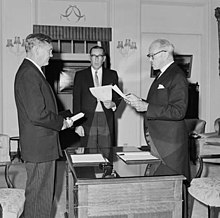
John Gorton being sworn in equally the 19th Prime Minister on 10 January 1968. To appointment, Gorton is the only Senator to have served as Prime number Minister, though he would swiftly move to the House of Representatives every bit the member for Higgins.
According to convention, the prime number minister is the leader of the majority party or largest party in a coalition of parties in the House of Representatives which holds the confidence of the House. The governor-general may also dismiss a prime number minister who is unable to pass the government'south supply beak through both houses of parliament, including the Australian Senate, where the government doesn't normally command the majority, as happened in the 1975 constitutional crisis.[7] Other commentators argue that the governor-full general acted improperly in 1975 equally Whitlam still retained the confidence of the House of Representatives, and there are no by and large accepted conventions to guide the utilize of the governor-full general'due south reserve powers in this circumstance.[8] Nonetheless, at that place is no constitutional requirement that the prime government minister sit in the House of Representatives, or fifty-fifty exist a member of the federal parliament (subject to a constitutionally prescribed limit of three months), though by convention this is e'er the case. The only case where a member of the Senate was appointed prime minister was John Gorton, who subsequently resigned his Senate position and was elected every bit the member for Higgins in the House of Representatives.
Despite the importance of the office of prime minister, the Constitution does not mention the office by name. The conventions of the Westminster organisation were idea to exist sufficiently entrenched in Australia past the authors of the Constitution that it was deemed unnecessary to particular these.[9] Indeed, prior to Federation in 1901 the terms "premier" and "prime minister" were used interchangeably for the head of government in a colony.[10]
If a authorities cannot get its appropriation (upkeep) legislation passed past the House of Representatives, or the Business firm passes a vote of "no confidence" in the authorities, the prime number minister is bound by convention to either resign or immediately advise the governor-general to deliquesce the House of Representatives and hold a fresh election.[ citation needed ]
Following a resignation in other circumstances or the death of a prime minister, the governor-full general generally appoints the deputy prime number minister equally the new prime minister, until or if such time as the governing party or senior coalition party elects an alternative party leader. This has resulted in the party leaders from the Country Political party (now named National Party) existence appointed as prime number minister, despite being the smaller party of their coalition. This occurred when Earle Page became flagman prime minister following the death of Joseph Lyons in 1939, and when John McEwen became caretaker prime minister following the disappearance of Harold Holt in 1967. Yet, in 1941, Arthur Fadden became the leader of the Coalition and subsequently prime minister past the agreement of both coalition parties, despite being the leader of the smaller political party in coalition, following the resignation of UAP leader Robert Menzies.
Excluding the brief transition periods during changes of government or leadership elections, there have merely been a scattering of cases where someone other than the leader of the majority political party in the House of Representatives was prime government minister:
- Federation occurred on 1 January 1901, but elections for the offset parliament were not scheduled until late March. In the interim, an unelected flagman government was necessary. In what is now known equally the Hopetoun Corrigendum, the governor-general, Lord Hopetoun, invited Sir William Lyne, the premier of the nigh populous state, New South Wales, to grade a regime. Lyne was unable to do then and returned his committee in favour of Edmund Barton, who became the get-go prime government minister and led the inaugural government into and beyond the election.
- During the second parliament, three parties (Free Trade, Protectionist and Labor) had roughly equal representation in the House of Representatives. The leaders of the three parties, Alfred Deakin, George Reid and Chris Watson each served as prime minister before losing a vote of confidence.
- As a outcome of the Labor Party'southward split up over conscription, Baton Hughes and his supporters were expelled from the Labor Political party in November 1916. He subsequently continued on every bit prime minister at the caput of the new National Labor Political party, which had but 14 members out of a full of 75 in the Business firm of Representatives. The Commonwealth Liberal Political party – despite still forming the official Opposition – provided confidence and supply until February 1917, when the two parties agreed to merge and formed the Nationalist Party.
- During the 1975 constitutional crisis, on 11 November 1975, the governor-general, Sir John Kerr, dismissed the Labor Party's Gough Whitlam every bit prime minister. Despite Labor holding a bulk in the Firm of Representatives, Kerr appointed the Leader of the Opposition, Liberal leader Malcolm Fraser as caretaker prime number government minister, conditional on the passage of the Whitlam government's Supply bills through the Senate and the calling of an election for both houses of parliament. Fraser accepted these terms and immediately advised a double dissolution. An election was called for xiii December, which the Liberal Party won in its own correct (although the Liberals governed in a coalition with the Country Political party).
Powers and role [edit]
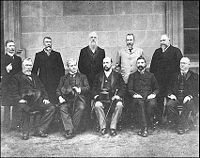
The first prime minister of Australia, Edmund Barton (sitting second from left), with his Chiffonier, 1901.
Most of the prime minister'due south ability derives from being the head of government.[11] In exercise, the Federal Executive Council acts to ratify all executive decisions made by the regime and requires the support of the prime minister. The powers of the prime minister are to direct the governor-general through advice to grant royal assent to legislation, to deliquesce and prorogue parliament, to call elections and to brand government appointments, which the governor-full general follows co-ordinate to convention.
The Constitution divides power betwixt the federal government and the states, and the prime minister is constrained by this.[12]
The formal ability to appoint the governor-general lies with the Queen of Australia, on the advice of the prime number government minister, whereby convention holds that the queen is bound to follow the advice. The prime number government minister can too suggest the monarch to dismiss the governor-general, though it remains unclear how quickly the monarch would deed on such advice in a ramble crisis. This uncertainty, and the possibility of a "race" betwixt the governor-general and prime government minister to dismiss the other, was a key question in the 1975 constitutional crisis. Prime number ministers whose government loses a vote of no-confidence in the House of Representatives, are expected to suggest the governor-general to dissolve parliament and hold an ballot, if an alternative government cannot be formed. If they neglect to practice this, the governor-full general may past convention dissolve parliament or appoint an alternative government.[7]
The prime minister is also the responsible minister for the Department of the Prime number Government minister and Cabinet, which is tasked with supporting the policy agendas of the prime minister and Cabinet through policy advice and the coordination of the implementation of key government programs, to manage Aboriginal and Torres Strait Islander policy and programs and to promote reconciliation, to provide leadership for the Australian Public Service alongside the Australian Public Service Commission, to oversee the honours and symbols of the Republic, to provide back up to ceremonies and official visits, to ready whole of government service delivery policy, and to coordinate national security, cyber, counter-terrorism, regulatory reform, cities, population, information, and women'due south policy.[13] Since 1992, the prime government minister also acts as the chair of the Quango of Australian Governments (COAG), an intergovernmental forum between the federal government and the state governments in which the prime minister, the land premiers and primary ministers, and a representative of local governments run into annually.[fourteen]
Privileges of office [edit]
Bacon [edit]
| Constructive date | Bacon | Ref. |
|---|---|---|
| ii June 1999 | $289,270 | |
| 6 September 2006 | $309,270 | |
| one July 2007 | $330,356 | |
| 1 October 2009 | $340,704 | [15] |
| 1 August 2010 | $354,671 | [16] |
| 1 July 2011 | $366,366 | |
| one Dec 2011 | $440,000 | |
| 15 March 2012 | $481,000 | [17] |
| i July 2012 | $495,430 | [18] |
| 1 July 2013 | $507,338 | [19] |
| 1 January 2016 | $517,504 | [twenty] |
| 1 July 2017 | $527,852 | [21] |
| i July 2018 | $538,460 | [22] |
| 1 July 2019 | $549,250 | [22] |
As of 1 July 2019, Commonwealth of australia's prime minister is paid a total salary of $549,250. This is made upwardly of the 'base bacon' received by all Members of Parliament ($211,250) plus a 160 percentage 'additional bacon' for the role of prime minister.[23] Increases in the base salary of MPs and senators are adamant annually past the independent Remuneration Tribunal.[22]
Residences and ship [edit]

While in office, the prime number minister has 2 official residences. The primary official residence is The Gild in Canberra. Most prime number ministers have chosen The Lodge as their chief residence because of its security facilities and close proximity to Parliament Firm. In that location have been some exceptions, however. James Scullin preferred to live at the Hotel Canberra (now the Hyatt Hotel) and Ben Chifley lived in the Hotel Kurrajong. More recently, John Howard used the Sydney prime ministerial residence, Kirribilli House, every bit his master accommodation. On her appointment on 24 June 2010, Julia Gillard said she would not be living in The Society until such time every bit she was returned to office by pop vote at the next general election, as she became prime government minister by replacing an incumbent during a parliamentary term. Tony Abbott was never able to occupy The Lodge during his term (2013–15) because it was undergoing extensive renovations, which continued into the early part of his successor Malcolm Turnbull'south term.[24] Instead, Abbott resided in dedicated rooms at the Australian Federal Law College when in Canberra.
During his beginning term, Rudd had a staff at The Lodge consisting of a senior chef and an assistant chef, a kid carer, one senior firm attendant, and two junior house attendants. At Kirribilli Business firm in Sydney, there are a total-time chef and a full-fourth dimension house bellboy.[25] The official residences are fully staffed and catered for both the prime minister and their family unit. In improver, both accept all-encompassing security facilities. These residences are regularly used for official entertaining, such as receptions for Australian of the Year finalists.
The prime minister receives a number of transport amenities for official business organisation. The Royal Australian Air Forcefulness's Airbus A330 MRTT, or KC30-A, transports the prime government minister within Australia and overseas[26]. The call-sign for the aircraft is "Envoy". For ground travel, the prime minister is transported in an armoured BMW seven Series model. Information technology is referred to as "C-1", or Republic Ane, because of its number plate. Information technology is escorted by police vehicles from state and federal government.[27]
- Privileges of function
-

-

-

-

After office [edit]
Politicians, including prime ministers, are ordinarily granted certain privileges afterward leaving office, such as role accommodation, staff assistance, and a Life Golden Laissez passer which entitles the holder to travel within Australia for "not-commercial" purposes at government expense. In 2017, then prime minister Malcolm Turnbull said the pass should exist available just to old prime ministers, though he would not use it when he was no longer PM.[28]
Just one prime minister who had left the Federal Parliament e'er returned. Stanley Bruce was defeated in his own seat in 1929 while prime government minister only was re-elected to parliament in 1931. Other prime ministers were elected to parliaments other than the Australian federal parliament: Sir George Reid was elected to the U.k. Firm of Commons (afterwards his term every bit Loftier Commissioner to the UK), and Frank Forde was re-elected to the Queensland Parliament (afterwards his term as High Commissioner to Canada, and a failed attempt to re-enter the Federal Parliament).
Acting prime ministers and succession [edit]
The deputy prime government minister becomes interim prime minister if the prime minister is unable to undertake the role for a short time, for example if they are ill, overseas or on leave (and if both are unavailable, and so another senior minister takes on this office).[29] The Acts Estimation Human action 1901 confers upon acting ministers "the same power and authority with respect to the absent Minister'due south statutory responsibilities".[30] [31]
If the prime minister were to dice, then the deputy prime government minister would be appointed prime minister by the governor-general until the authorities votes for some other member to exist its leader.[29] This happened when Harold Holt disappeared in 1967,[29] when John McEwen was appointed prime number government minister.[32] On the other two occasions that the prime minister has died in office, in 1939 and 1945, Earle Page and Frank Forde, respectively, were appointed prime minister.[32]
In the early 20th century, overseas travel mostly required long journeys past ship. As a event, some held the position of acting prime minister for meaning periods of time, including William Watt (16 months, 1918–1919),[33] George Pearce (seven months, 1916),[34] Alfred Deakin (six months, 1902),[35] Joseph Melt (5 months, 1921),[36] James Fenton (19 weeks, 1930–1931),[37] John Forrest (4 months, 1907),[38] and Arthur Fadden (four months, 1941). Fadden was acting prime government minister for a cumulative total of 676 days (over 22 months) between 1941 and 1958.[39]
Honours [edit]
Prime ministers have been granted numerous honours, typically after their menses as prime minister has concluded, with a few exceptions.
Nine old prime ministers were awarded knighthoods: Barton (GCMG, 1902),[40] Reid (GCMG, 1911),[41] Melt (GCMG, 1918),[42] Page (GCMG, 1938),[43] Menzies (KT, 1963),[44] Fadden (KCMG, 1951),[45] McEwen (GCMG, 1971),[46] Gorton (GCMG, 1977),[47] and McMahon (GCMG, 1977).[48] Of those awarded, Barton and Menzies were knighted while still serving as prime government minister, with Folio awarded his before condign prime number minister, and the rest awarded afterwards leaving office. Reid (GCB, 1916),[49] Menzies (AK, 1976)[50] and Fadden (GCMG, 1958)[51] were awarded a second knighthood after leaving office.
Non-titular honours were also bestowed on former prime ministers, usually the Order of the Companions of Honour. This accolade was awarded to Bruce (1927),[52] Lyons (1936),[53] Hughes (1941),[54] Folio (1942),[55] Menzies (1951),[56] Holt (1967),[57] McEwen (1969),[58] Gorton (1971),[59] McMahon (1972),[60] and Fraser (1977),[61] mostly during office as prime minister.
In almost all occasions these honours were simply accustomed past non-Labor/conservative prime ministers. However, engagement to the Privy Council of the United Kingdom was accepted by all prime number ministers until 1983 (with the exception of Alfred Deakin, Chris Watson and Gough Whitlam), with Malcolm Fraser being the terminal prime ministerial appointee.
Since its introduction in 1975, former prime number ministers of Australia have been appointed to the Order of Commonwealth of australia and to its highest level – Companion: Whitlam (1978),[62] Fraser (1988),[63] Gorton (1988),[64] Howard (2008),[65] Gillard (2017),[66] Rudd (2019),[67] Abbott (2020),[68] and Turnbull (2021).[69] Keating refused appointment in the 1997 Australia Day Honours, saying that he had long believed honours should be reserved for those whose work in the community went unrecognised and that having been Prime Minister was sufficient public recognition.[70] [71] Bob Hawke was appointed a Companion in 1979, for service to trade unionism and industrial relations, before becoming prime government minister in 1983.[72] Menzies was appointed to the higher grade of Knight of the Gild, which is no longer awarded, in 1976.
John Howard was likewise appointed to the Gild of Merit, whose appointments are within the personal gift of the Queen, in 2012.[73]
In addition to these honours, all deceased former prime ministers of Australia currently have federal electorates named after them, with the exception of Joseph Cook (a Division of Cook does be, but information technology is named later explorer James Cook). The most recently created of these electorates is the Sectionalization of Hawke, named in honour of the recently deceased Bob Hawke in 2021.
List [edit]
The longest-serving prime minister was Robert Menzies, who served in function twice: from 26 April 1939 to 28 August 1941, and over again from 19 Dec 1949 to 26 January 1966. In total Robert Menzies spent 18 years, 5 months and 12 days in office. He served nether the United Australia Political party and the Liberal Party respectively.
The shortest-serving prime minister was Frank Forde, who was appointed to the position on half-dozen July 1945 afterward the expiry of John Curtin, and served until 13 July 1945 when Ben Chifley was elected leader of the Australian Labor Party.
The concluding prime minister to serve out a full government term in the office was John Howard, who won the 2004 ballot and led his political party to the 2007 election, but lost. Since then, the five subsequent prime ministers have been either voted out of the office mid-term by the caucuses of their own parties, causeless the function mid-term under such circumstances, or both.
| No. | Name (birth–decease) | Portrait | Party | Term of part | Elections won | Ministry | |
|---|---|---|---|---|---|---|---|
| i | Edmund Barton (1849–1920) |  | Protectionist | 1 Jan 1901 | 24 September 1903 | 1901 | Barton |
| two | Alfred Deakin (1856–1919) |  | Protectionist | 24 September 1903 | 27 Apr 1904 | 1903 | 1st Deakin |
| 3 | Chris Watson (1867–1941) |  | Labor | 27 April 1904 | xviii August 1904 | — | Watson |
| 4 | George Reid (1845–1918) |  | Gratis Trade | 18 August 1904 | 5 July 1905 | — | Reid |
| (ii) | Alfred Deakin (1856–1919) |  | Protectionist | v July 1905 | 13 November 1908 | 1906 | 2nd Deakin |
| 5 | Andrew Fisher (1862–1928) |  | Labor | thirteen November 1908 | 2 June 1909 | — | 1st Fisher |
| (ii) | Alfred Deakin (1856–1919) |  | Liberal | 2 June 1909 | 29 April 1910 | — | 3rd Deakin |
| (5) | Andrew Fisher (1862–1928) |  | Labor | 29 April 1910 | 24 June 1913 | 1910 | 2nd Fisher |
| 6 | Joseph Melt (1860–1947) |  | Liberal | 24 June 1913 | 17 September 1914 | 1913 | Cook |
| (5) | Andrew Fisher (1862–1928) |  | Labor | 17 September 1914 | 27 Oct 1915 | 1914 | third Fisher |
| Billy Hughes (1862–1952) |  | Labor | 27 October 1915 | xiv Nov 1916 | — | 1st Hughes | |
| 7 | National Labor | 14 November 1916 | 17 February 1917 | – | 2nd Hughes | ||
| Nationalist | 17 February 1917 | 9 February 1923 | – | 3rd Hughes | |||
| 1917 | 4th Hughes | ||||||
| 1919 | 5th Hughes | ||||||
| 8 | Stanley Bruce (1883–1967) |  | Nationalist (Coalition) | ix February 1923 | 22 October 1929 | 1922 | 1st Bruce |
| 1925 | 2nd Bruce | ||||||
| 1928 | 3rd Bruce | ||||||
| ix | James Scullin (1876–1953) |  | Labor | 22 October 1929 | 6 January 1932 | 1929 | Scullin |
| x | Joseph Lyons (1879–1939) |  | United Commonwealth of australia (Coalition after Nov. 1934) | half-dozen January 1932 | 7 Apr 1939† | 1931 | 1st Lyons |
| 1934 | 2nd Lyons | ||||||
| — | 3rd Lyons | ||||||
| 1937 | 4th Lyons | ||||||
| 11 | Earle Page (1880–1961) |  | State (Coalition) | 7 April 1939 | 26 April 1939 | — | Page (Caretaker) |
| 12 | Robert Menzies (1894–1978) |  | United Australia (Coalition after Mar. 1940) | 26 April 1939 | 29 August 1941 | — | 1st Menzies |
| second Menzies | |||||||
| 1940 | 3rd Menzies | ||||||
| xiii | Arthur Fadden (1894–1973) |  | Country (Coalition) | 29 August 1941 | 7 October 1941 | — | Fadden |
| fourteen | John Curtin (1885–1945) |  | Labor | 7 October 1941 | 5 July 1945† | — | 1st Curtin |
| 1943 | 2nd Curtin | ||||||
| fifteen | Frank Forde (1890–1983) |  | Labor | vi July 1945 | thirteen July 1945 | — | Forde (Caretaker) |
| 16 | Ben Chifley (1885–1951) |  | Labor | 13 July 1945 | 19 December 1949 | — | 1st Chifley |
| 1946 | second Chifley | ||||||
| (12) | Robert Menzies (1894–1978) |  | Liberal (Coalition) | 19 Dec 1949 | 26 January 1966 | 1949 | 4th Menzies |
| 1951 | 5th Menzies | ||||||
| 1954 | 6th Menzies | ||||||
| 1955 | 7th Menzies | ||||||
| 1958 | 8th Menzies | ||||||
| 1961 | 9th Menzies | ||||||
| 1963 | 10th Menzies | ||||||
| 17 | Harold Holt (1908–1967) |  | Liberal (Coalition) | 26 January 1966 | xix Dec 1967† | — | 1st Holt |
| 1966 | 2d Holt | ||||||
| 18 | John McEwen (1900–1980) |  | Country (Coalition) | 19 Dec 1967 | 10 January 1968 | — | McEwen (Caretaker) |
| 19 | John Gorton (1911–2002) |  | Liberal (Coalition) | 10 January 1968 | 10 March 1971 | — | 1st Gorton |
| 1969 | 2d Gorton | ||||||
| 20 | William McMahon (1908–1988) |  | Liberal (Coalition) | 10 March 1971 | 5 Dec 1972 | — | McMahon |
| 21 | Gough Whitlam (1916–2014) |  | Labor | v Dec 1972 | 11 November 1975 | 1972 | 1st Whitlam |
| — | 2nd Whitlam | ||||||
| 1974 | third Whitlam | ||||||
| 22 | Malcolm Fraser (1930–2015) |  | Liberal (Coalition) | xi November 1975 | xi March 1983 | — | 1st Fraser |
| 1975 | 2nd Fraser | ||||||
| 1977 | 3rd Fraser | ||||||
| 1980 | 4th Fraser | ||||||
| 23 | Bob Hawke (1929–2019) |  | Labor | eleven March 1983 | 20 December 1991 | 1983 | 1st Hawke |
| 1984 | second Hawke | ||||||
| 1987 | 3rd Hawke | ||||||
| 1990 | quaternary Hawke | ||||||
| 24 | Paul Keating (1944–) |  | Labor | 20 Dec 1991 | 11 March 1996 | — | 1st Keating |
| 1993 | 2d Keating | ||||||
| 25 | John Howard (1939–) |  | Liberal (Coalition) | 11 March 1996 | 3 December 2007 | 1996 | 1st Howard |
| 1998 | 2nd Howard | ||||||
| 2001 | 3rd Howard | ||||||
| 2004 | 4th Howard | ||||||
| 26 | Kevin Rudd (1957–) |  | Labor | 3 Dec 2007 | 24 June 2010 | 2007 | 1st Rudd |
| 27 | Julia Gillard (1961–) |  | Labor | 24 June 2010 | 27 June 2013 | — | 1st Gillard |
| 2010 | second Gillard | ||||||
| (26) | Kevin Rudd (1957–) |  | Labor | 27 June 2013 | 18 September 2013 | — | second Rudd |
| 28 | Tony Abbott (1957–) |  | Liberal (Coalition) | 18 September 2013 | 15 September 2015 | 2013 | Abbott |
| 29 | Malcolm Turnbull (1954–) |  | Liberal (Coalition) | 15 September 2015 | 24 August 2018 | — | 1st Turnbull |
| 2016 | 2nd Turnbull | ||||||
| xxx | Scott Morrison (1968–) |  | Liberal (Coalition) | 24 August 2018 | Incumbent | — | 1st Morrison |
| 2019 | 2nd Morrison | ||||||
See besides [edit]
- Historical rankings of prime number ministers of Australia
- Listing of Commonwealth heads of regime
- Listing of prime ministers of Australia
- Listing of prime ministers of Australia (graphical)
- List of prime number ministers of Australia by time in office
- List of prime ministers of Elizabeth Ii
- Prime Ministers Artery in Horse Chestnut Avenue in the Ballarat Botanical Gardens contains a collection of statuary busts of one-time Australian prime ministers.
- Prime Ministers' Corridor of Oaks in Faulconbridge, New South Wales contains a corridor of oaks of former Australian prime ministers.
- Prime Minister'south XI
- Spouse of the prime minister of Commonwealth of australia
- Leader of the Opposition (Australia)
References [edit]
- ^ "Contact Your PM". Prime Minister of Australia . Retrieved 29 May 2020.
- ^ "How to accost Senators and Members". Retrieved 26 Apr 2021.
- ^ a b c "Prime Government minister". Parliamentary Education Office . Retrieved 29 May 2020.
- ^ a b c "Prime Ministers". Australian Prime Ministers Centre, Old Parliament House . Retrieved 29 May 2020.
- ^ "Salary". Ministerial and Parliamentary Services, Department of Finance. iii February 2020. Archived from the original on 23 June 2021. Retrieved 29 May 2020.
- ^ "No. 14 - Ministers in the Senate". Senate Briefs. Parliament of Australia. December 2016.
- ^ a b Kerr, John. "Statement from John Kerr (dated 11 November 1975) explaining his decisions". WhitlamDismissal.com. Archived from the original on 23 February 2012. Retrieved xi January 2017.
- ^ Australia'due south Constitution : With Overview and Notes past the Australian Regime Solicitor (Pocket ed.). Canberra: Parliamentary Didactics Office and Australian Government Solicitor. 2010. p. v. ISBN9781742293431.
- ^ Spry, Dr Max (1996). "The Executive Ability of the commonwealth: its telescopic and limits". Parliament of Commonwealth of australia . Retrieved ten August 2021.
- ^ "The Premiers' Conference - Text of the Resolutions". The Age. 23 Baronial 1898. Retrieved five Dec 2019.
- ^ "Infosheet xx - The Australian system of authorities". Parliament of Australia . Retrieved xxx July 2020.
- ^ "Prime Government minister: Roles, Powers and Restraints". Australian Politics.
- ^ "Authoritative Arrangements Order". Department of the Prime Minister and Cabinet. Democracy of Australia. ane September 2016. Retrieved xi Jan 2017.
- ^ "Federation Homepage | Federation".
- ^ "Prime number Minister Kevin Rudd and MPs in line to get a 3% pay ascension".
- ^ Hudson, Phillip (25 Baronial 2010). "Politicians awarded secret pay ascent". Herald Dominicus. Commonwealth of australia. Archived from the original on 6 March 2019. Retrieved 25 August 2010.
- ^ [1] Archived 13 April 2013 at the Wayback Auto
- ^ "Tony Abbott defends increment in MP salary, maxim he'due south working hard for every Australian". Herald Sunday. 5 July 2012. Archived from the original on 2 Dec 2013. Retrieved 4 July 2012.
- ^ Peatling, Stephanie (xiv June 2013). "PM's salary tops $500,000". The Sydney Morn Herald.
- ^ Mannheim, Markus (x December 2015). "Politicians, judges and height public servants to proceeds 2% pay ascent afterward wage freeze". The Canberra Times.
- ^ "Politicians nether fire for pay increases while penalization rates cut, One Nation wants to reject rising". 23 June 2017.
- ^ a b c "What practice Federal Members of Parliament get paid?". Remuneration Tribunal. Archived from the original on 26 November 2020. Retrieved 21 January 2019.
- ^ "Parliamentary Offices". Remuneration Tribunal . Retrieved 2 July 2019.
- ^ Canberra Times, 18 August 2017. Retrieved 12 June 2018
- ^ Metherell, Mark (19 February 2008). "Rudds' staff extends to a child carer at the Lodge". The Sydney Morning time Herald . Retrieved 24 June 2010.
- ^ "ScoMo dubs his new plane 'Shark One'". Australian Financial Review. 8 September 2019. Retrieved 6 May 2022.
- ^ CarAdvice.com.au (vi April 2009). "25% of government car fleet strange made". Auto Communication. Retrieved 12 December 2011.
- ^ Hutchens, Gareth (7 February 2017). "Malcolm Turnbull to scrap Life Gold Laissez passer for former MPs". the Guardian.
- ^ a b c "Does Commonwealth of australia have a parliamentary line of succession to the Prime Minister and if and then, what is the club?". Parliamentary Education Office . Retrieved 18 Baronial 2021.
{{cite web}}: CS1 maint: url-status (link) - ^ "The Ministry". Business firm of Representatives Practice (7th ed.). Parliament of Australia. Retrieved 16 December 2019.
- ^ Acts Interpretation Act 1901, south 19(4).
- ^ a b "Australia'southward PMs and how they left function". SBS News. 24 August 2018. Retrieved 18 August 2021.
{{cite web}}: CS1 maint: url-status (link) - ^ "Watt, William Alexander (1871–1946)". Australian Dictionary of Biography. Vol. 12. 1990.
- ^ Beddie, B. (1988). "Pearce, Sir George Foster (1870–1952)". Australian Dictionary of Biography. Vol. 11.
- ^ Norris, R. (1981). "Deakin, Alfred (1856–1919)". Australian Dictionary of Biography. Melbourne University Press. ISSN 1833-7538 – via National Center of Biography, Australian National Academy.
- ^ Crowley, F.Grand. Cook, Sir Joseph (1860–1947). Australian Lexicon of Biography. Australian National University. Retrieved 24 April 2016.
- ^ Robertson, J. R. (1981). "Fenton, James Edward (1864–1950)". Australian Dictionary of Biography. Vol. eight.
- ^ Crowley, Frank. Forrest, Sir John (1847–1918). Australian Lexicon of Biography.
- ^ Arklay, Tracey Chiliad. (2010). Arthur Fadden: A Political Silhouette (PDF) (PhD thesis). Griffith Academy. p. 196. Archived from the original (PDF) on 28 May 2018. Retrieved 16 December 2019.
- ^ "No. 27448". The London Gazette (Supplement). 26 June 1902. pp. 4189–4196.
- ^ "GCMG". Department of Prime Government minister and Cabinet.
- ^ "No. 30831". The London Gazette (Supplement). 6 August 1918. p. 9264.
- ^ "GCMG". Section of Prime Minister and Chiffonier.
- ^ "KT". Section of Prime Government minister and Cabinet.
- ^ Information technology'south an Honour - Fadden KCMG Archived 2 October 2008 at the Wayback Motorcar
- ^ "GCMG". Department of Prime number Minister and Cabinet.
- ^ It's an Honour Archived 26 May 2011 at the Wayback Machine – Knight Grand Cross of the Lodge of St Michael and St George
- ^ "It's an Honour – GCMG". Itsanhonour.gov.au. 12 June 1977. Archived from the original on 26 May 2011. Retrieved 25 Apr 2010.
- ^ "GCB". Department of Prime number Government minister and Chiffonier.
- ^ "AK". Department of Prime Government minister and Chiffonier.
- ^ "GCMG". Department of Prime Minister and Cabinet.
- ^ "CH". Department of Prime Minister and Cabinet.
- ^ "Mr Joseph Aloysius LYONS". It's An Honor. Department of the Prime Minister and Cabinet. Retrieved 2 April 2019.
- ^ "Information technology's an Honour". Archived from the original on 13 November 2013. Retrieved iv January 2012.
- ^ "It'southward an Honour – CH". Itsanhonour.gov.au. 26 June 1942. Archived from the original on 9 November 2018. Retrieved 4 November 2011.
- ^ "It's an Honor: CH". Australian Government. Archived from the original on iv June 2011. Retrieved fifteen October 2009.
- ^ "CH". Section of Prime Minister and Chiffonier.
- ^ "CH". Department of Prime Government minister and Cabinet.
- ^ "CH". Department of Prime Minister and Cabinet.
- ^ "CH". Department of Prime Minister and Cabinet.
- ^ "CH". Department of Prime number Minister and Cabinet.
- ^ "Ac". Department of Prime number Government minister and Cabinet.
- ^ "AC". Department of Prime Minister and Cabinet.
- ^ Information technology's an Honour Archived 26 May 2011 at the Wayback Automobile – Companion of the Order of Commonwealth of australia
- ^ Information technology'southward an Honour: Air-conditioning, Australian Government, ix June 2008, archived from the original on 21 September 2016, retrieved 20 June 2017
- ^ "It's an Accolade: AC", Itsanhonour.gov.au, Government of Australia, 26 Jan 2017, retrieved 26 Jan 2017
- ^ "AC". Department of Prime Government minister and Cabinet.
- ^ Queen'due south Birthday Honours 2020 (PDF), Governor Full general, retrieved vii June 2020
- ^ Australia Day Honours 2021, Governor General, retrieved 29 January 2021
- ^ "After office". Australia'south PMs – Paul Keating. National Archives of Commonwealth of australia. Retrieved fifteen July 2010.
- ^ "Keating: gone wrong". The Lord's day-Herald. 26 January 1997. p. 3.
- ^ "It's an Award". Authorities of Australia. Archived from the original on 18 May 2019. Retrieved 3 September 2007.
- ^ "No. 60028". The London Gazette. 12 January 2012. p. 485.
Further reading [edit]
- Abjorensen, Norman (2015). The Style of Their Going: Prime Ministerial Exits from Lyne to Abbott. Australian Scholarly. ISBN9781925333213.
- Grattan, Michelle (2016). Australian Prime Ministers. New Holland. ISBN9781742579337.
- Hughes, Colin (1976). Mr Prime Minister: Australian Prime Ministers 1901–1972. Oxford University Press. ISBN0195504712.
- Strangio, Paul (2013). "Evaluating Prime number-Ministerial Functioning: The Australian Experience". In Strangio, Paul; 't Hart, Paul; Walter, James (eds.). Understanding Prime-Ministerial Performance: Comparative Perspectives. Oxford University Press. ISBN9780199666423.
- Strangio, Paul; 't Hart, Paul; Walter, James (2016). Settling the Office: The Australian Prime Ministership from Federation to Reconstruction. Melbourne University Press. ISBN9780522868722.
- Strangio, Paul; 't Hart, Paul; Walter, James (2017). The Pin of Power: Australian Prime Ministers and Political Leadership, 1949-2016. Melbourne University Press. ISBN9780522868746.
- Whitington, Don (1972). Twelfth Man?. Jacaranda Printing. ISBN0701605855.
External links [edit]
- Official website of the prime number minister of Commonwealth of australia
- Section of Prime Minister and Cabinet
- Australia's Prime Ministers – National Archives of Commonwealth of australia reference site and research portal
- Biographies of Australia's Prime Ministers / National Museum of Australia
- Classroom resources on Australian Prime Ministers
- Museum of Australian Democracy website about Australian prime number ministers
Source: https://en.wikipedia.org/wiki/Prime_Minister_of_Australia
0 Response to "Is This True Australian Minister Does It Again"
Post a Comment